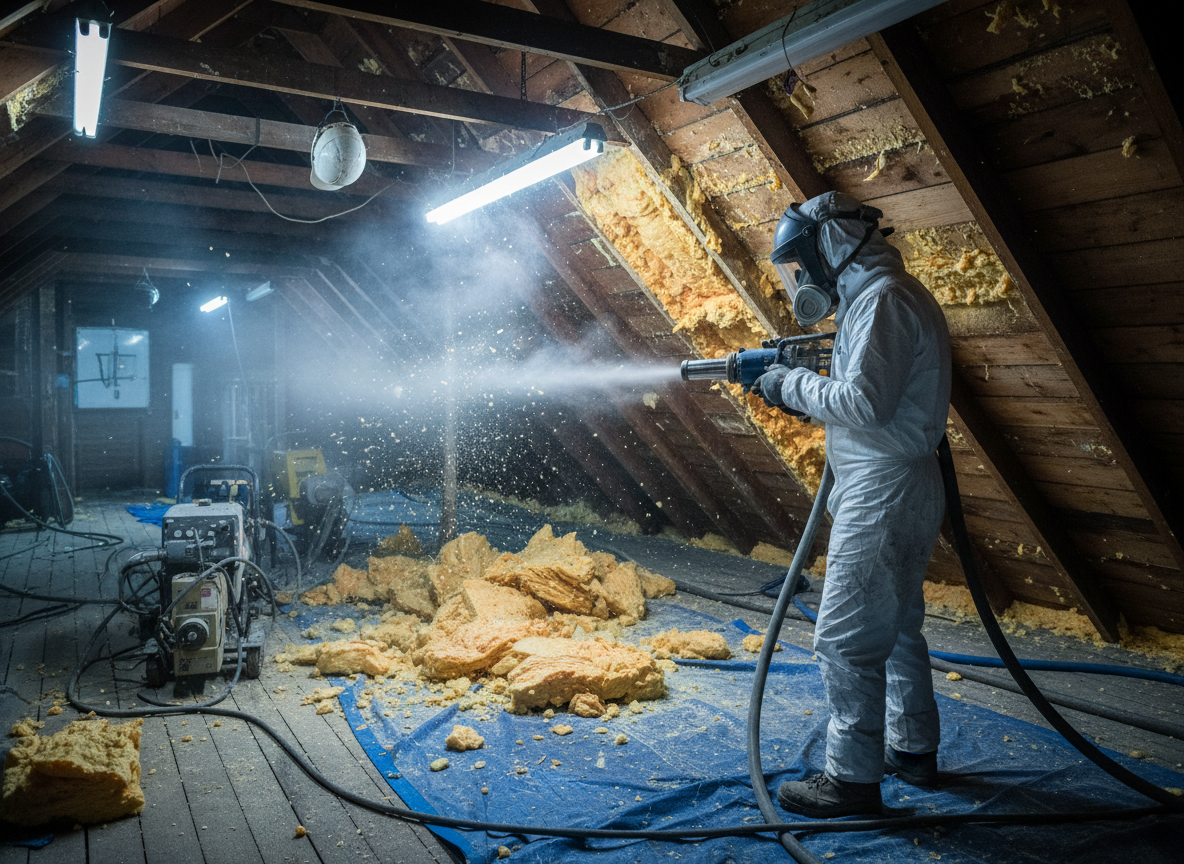
Hull's Victorian terraces and post-war semis often hold closed-cell spray foam installed decades ago that now traps damp against brickwork. Dry ice blasting uses solid CO2 pellets accelerated at high velocity to shatter the foam while leaving timber joists and plaster intact. The process avoids solvents that could react with the area's high groundwater and frequent rainfall, preventing further salt migration through the masonry.
Operators must account for limited loft access in narrow Hull back-to-backs where scaffolding or internal protection becomes essential. Pellets sublimate on contact, eliminating secondary waste that would otherwise need disposal under Yorkshire waste regulations. Edge cases include foam bonded to lead flashings or around chimney breasts where temperature control prevents cracking of historic materials.
Seasonal timing matters because Hull winters bring driving rain that can re-wet insulation remnants if extraction is incomplete. The method leaves surfaces dry enough for immediate inspection, unlike water-based removal that risks mould regrowth in the region's humid climate. Homeowners should expect full containment of dust and residue to protect adjacent living spaces during the work.
Technician insight
In Hull, the thing that catches most people out with dry ice blasting spray foam removal is how the constant damp from the Humber estuary makes foam bond tighter to brickwork than in drier inland counties, so you often need extra passes around eaves and gables to avoid leaving thin layers that trap moisture again.
Loft Extraction in a Hull Terrace
Spray foam in a 1930s terrace near the city centre had absorbed rainwater through failed roof tiles and caused ceiling staining. Inspection showed closed-cell foam adhering directly to rafters with no vapour barrier. Dry ice blasting cleared the material in two days without damaging original timber. The loft dried fully and the owner later added proper ventilation.
How it works
- 1
Site Assessment
Inspect foam depth, substrate condition and access routes in the Hull property to confirm dry ice blasting suitability.
- 2
Protection Setup
Cover floors, electrics and neighbouring rooms then establish ventilation to manage CO2 levels during blasting.
- 3
Dry Ice Application
Blast foam in controlled passes, adjusting pressure for different densities found in older Yorkshire installations.
- 4
Final Clearance
Vacuum residue, verify substrate cleanliness and advise on ventilation improvements to reduce future moisture issues.
Pricing
Cost depends on foam thickness, access difficulty and property size typical of Hull terraces.