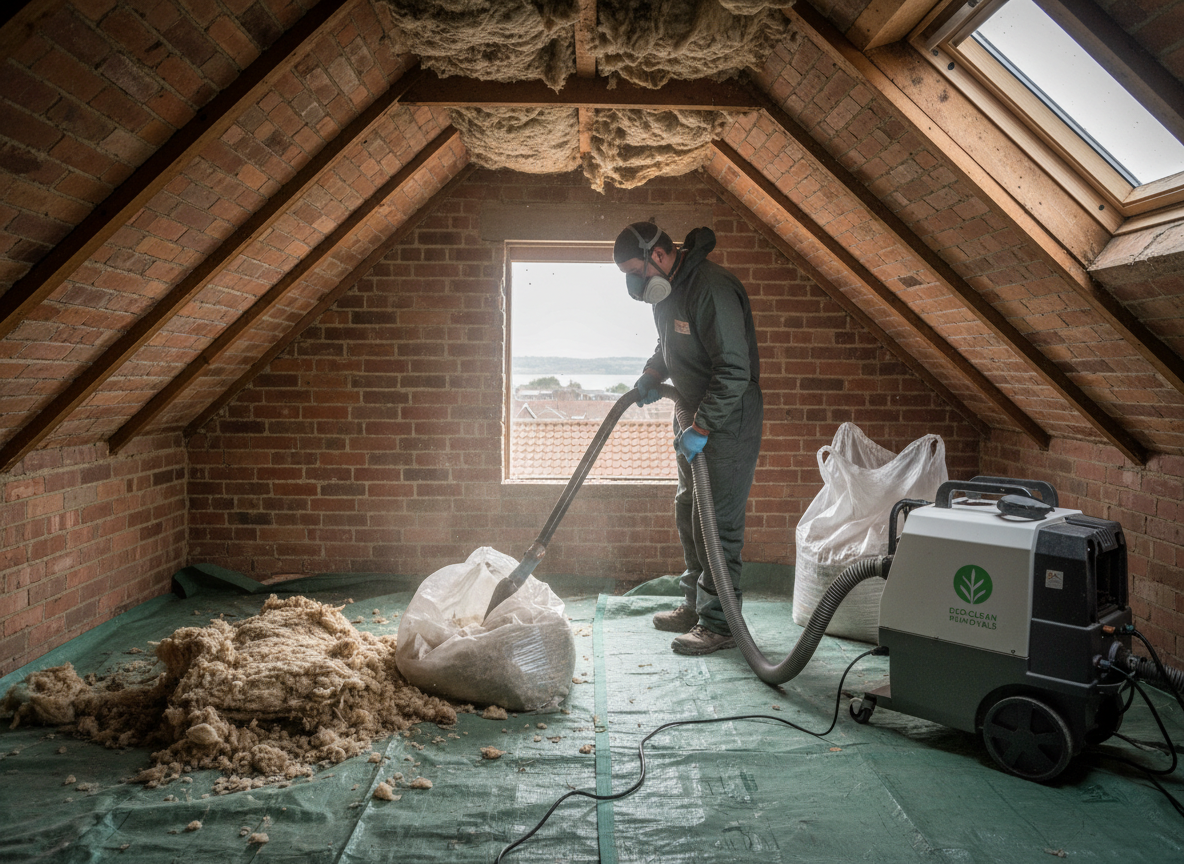
Hull's older terraced housing stock, particularly pre-1960s brick properties near the Humber, often received spray foam insulation in lofts and walls during the 2000s energy schemes. Over time the closed-cell material traps condensation against timber joists and brickwork, especially where ventilation was never upgraded for the region's frequent damp winters and coastal winds. Environmentally friendly removal starts with low-VOC enzymatic or mechanical stripping that breaks the foam into inert particles without releasing isocyanates into living spaces.
Edge cases appear regularly in Hull when foam was applied over existing mineral wool or in properties with shared chimney stacks; the foam bonds to shared masonry and pulls render or pointing loose during extraction. Technicians must isolate each terrace section, use negative-air machines vented through existing loft hatches, and bag waste for licensed transfer stations rather than general landfill. Homeowners should expect temporary loss of loft storage and possible re-plastering where foam pulled paint or paper from ceilings.
Local building control in the Hull area now requires proof that any replacement insulation meets current ventilation standards before re-occupation. Removal crews therefore document original rafter spacing, existing airflow gaps, and any timber decay uncovered so the property owner can show compliance if selling or claiming on insurance. The process also includes checking for asbestos in older artex ceilings common in HU1 and HU5 postcodes before any mechanical scraping begins.
Technician insight
In Hull, the thing that catches most people out with environmentally friendly insulation removal is how often 1930s terraces along the A63 or in the Fruit Market have foam sprayed straight over blocked eaves, so the moment you start pulling it you find years of trapped rainwater against the wall plate that needs treating before any new insulation goes back in.
Loft in HU5 Terrace
Homeowner noticed black mould on bedroom ceilings after heavy autumn rain. Inspection found closed-cell foam had sealed off the original eaves vents in a 1928 two-up two-down. Enzymatic removal exposed saturated joist ends; we treated the timber, restored airflow and left the loft dry with no chemical residue.
How it works
- 1
Initial Loft Inspection
Assess foam type, depth, ventilation gaps and any timber staining in Hull properties.
- 2
Containment Setup
Install negative air and dust barriers to protect living areas from particles.
- 3
Eco Foam Extraction
Apply enzymatic breakers followed by mechanical removal and HEPA vacuuming.
- 4
Responsible Disposal
Bag and transport inert waste to licensed Hull-area facilities.
- 5
Ventilation Restoration
Clear or add soffit and ridge vents to prevent future moisture issues.
Pricing
Cost depends on property age, foam thickness and access; upfront quotes provided after inspection.