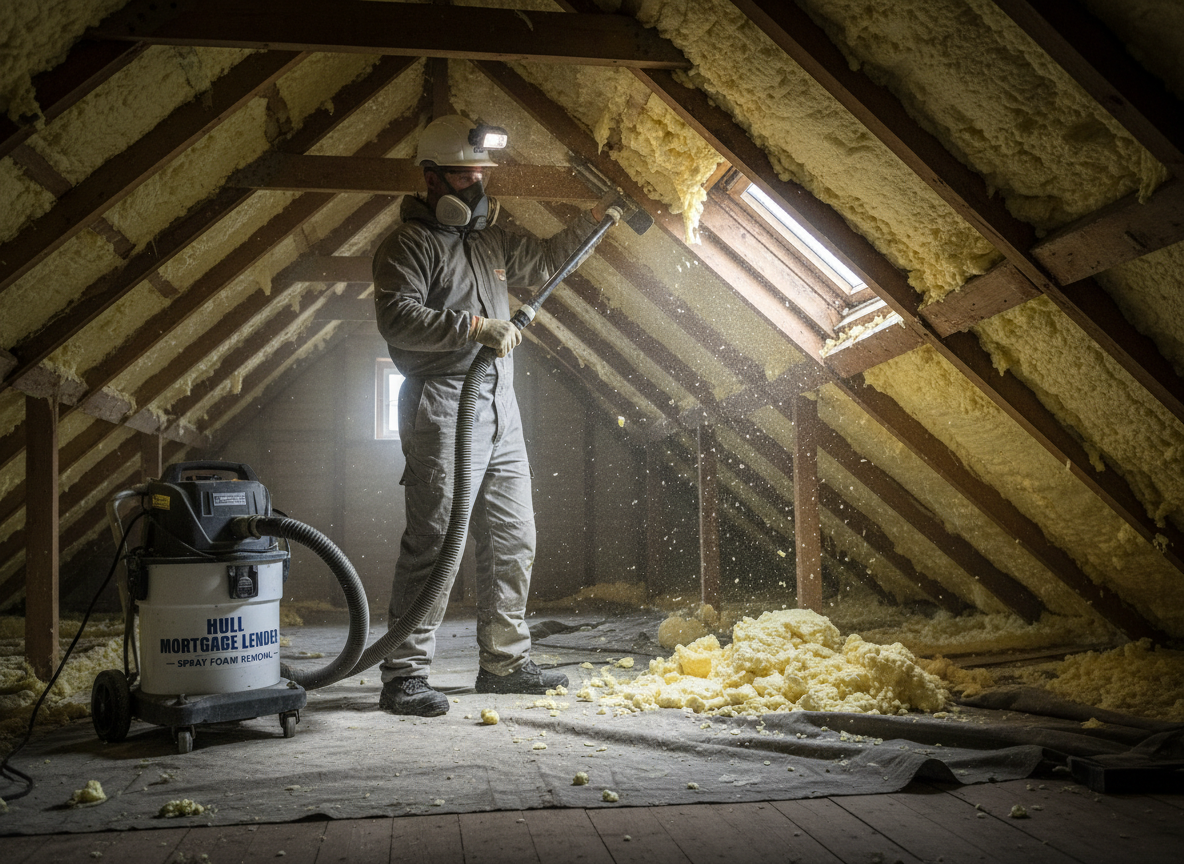
Hull's Victorian and Edwardian terraces often received spray foam insulation in the 2000s to cut heating costs. Many lenders now reject applications on these homes because closed-cell foam traps moisture against rafters and can hide timber decay. Removal requires careful cutting back to the original roof structure without disturbing original lath and plaster ceilings below, especially on streets around the Old Town and Holderness Road where properties sit close together and access is limited.
Coastal weather brings frequent rain and high humidity that accelerates rot once foam is disturbed. Technicians must work in short windows between showers and use temporary sheeting to keep water out of the roof void. In areas like Newland and Anlaby, narrow ginnels mean equipment is carried by hand rather than pumped in, adding time and care to avoid damage to neighbouring roofs.
Lenders typically require a full clear-out plus photographic evidence that the roof void is ventilated again. Any remaining foam residue on timbers must be removed because even thin layers can trigger further surveys. Properties near the Humber often show salt contamination in the foam, which makes standard scraping methods less effective and requires additional solvent treatment.
Work is carried out from 94 Alfred Gelder Street with 24/7 availability so homeowners facing chain delays can book around estate agent viewings and surveyor visits.
Technician insight
In Hull the thing that catches most people out with mortgage lender spray foam removal is how the foam bonds to the original sarking boards in 1890s terraces around the Fruit Market; once you start peeling you find the boards are already soft from years of trapped condensation and any heavy scraping brings the ceiling down in the bedroom below.
Terrace Loft Near Holderness Road
Homeowner needed the loft cleared before a Halifax valuation. We found closed-cell foam bonded to rafters and salt-stained from Humber moisture. After section-by-section removal and timber cleaning the surveyor signed off and the mortgage completed.
How it works
- 1
Initial Loft Survey
Assess foam type, depth, and condition of rafters and ceiling joists while checking for existing damp or rot.
- 2
Safe Removal
Cut and peel foam in sections, bagging waste on site to prevent dust settling through ceilings into living spaces.
- 3
Timber Cleaning
Scrape residue and treat any salt or mould staining so the roof meets lender inspection standards.
- 4
Ventilation Check
Confirm eaves and ridge vents are clear before handing over photos for the mortgage pack.
Pricing
Cost depends on loft size, foam thickness and access difficulty; we provide a fixed quote after the survey.